Fr
Fr De
De En
EnSalaries in Switzerland: Minimum wage & average pay in 2026
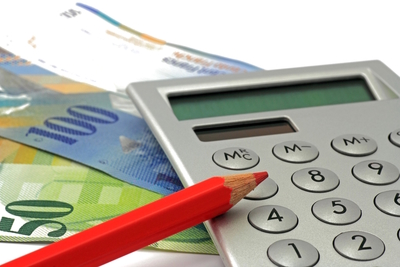
With a median gross monthly salary of CHF 7,024 (€7,432), Switzerland attracts many French- and German-speaking candidates, despite its high cost of living. What income can you realistically expect in Switzerland? What about health insurance, taxes and payslips? Here are the key points to keep in mind.
2. Average and median income in Switzerland
3. The Swiss tax system
4. Health insurance in Switzerland
5. Payslips in Switzerland
6. How to negotiate your salary in Switzerland?

There is no national legal minimum wage in Switzerland. Each canton can decide to introduce its own minimum wage to take local economic conditions and the cost of living into account.
In 2026, five cantons have a minimum wage, namely Geneva, Neuchâtel, Jura, Basel-Stadt and Ticino, while the other 21 cantons do not apply a cantonal legal minimum wage.
To better visualize the differences, here is a comparison of gross minimum wages, both hourly and monthly, in force in the different Swiss cantons in 2026:
| Hourly wage | Monthly wage (over 12 months) | |
|---|---|---|
| Geneva | CHF 24.59 | CHF 4,795.05 |
| Neuchâtel | CHF 21.35 | CHF 4,163.25 |
| Jura | CHF 21.40 | CHF 4,173.00 |
| Basel-Stadt | CHF 22.20 | CHF 4,329.00 |
| Ticino | CHF 20.00 to 20.50 | CHF 3,900 to 3,997.50 |
| 21 other cantons | No legal minimum |
📊 Tip: To quickly find the equivalent of your salary in euros, use the Swiss Franc (CHF) to Euro (€) converter based on the current exchange rate.
In 2026, the average gross monthly salary in Switzerland is estimated at CHF 7,900 (around €8,367). This level of remuneration places Switzerland among the highest-paying countries in Europe, supported by a strong economy, an attractive tax system and high productivity.
According to the latest data from the Federal Statistical Office (FSO), the median gross monthly salary in Switzerland is CHF 7,024 for a full-time position (CHF 6,666 for women compared with CHF 7,276 for men).
In Switzerland, a 13th-month salary is often paid to employees, usually in December. For most employees, the maximum weekly working time is set at 45 hours.
However, this average can be misleading, as it is pushed upwards by certain sectors offering salaries well above the national average:
| Industry | Gross monthly salary |
|---|---|
| Finance and banking | CHF 10,000 |
| Pharmaceuticals and biotechnology | CHF 9,500 |
| Information technology | CHF 8,500 |
| Healthcare and medical professions | CHF 8,000 |
| Education and research | CHF 6,000 to 7,000 |
| Hospitality and catering | CHF 5,000 |
📌 Good to know: The highest salaries are found in particular in Zurich and Geneva, while remuneration levels are lower in regions such as Ticino.
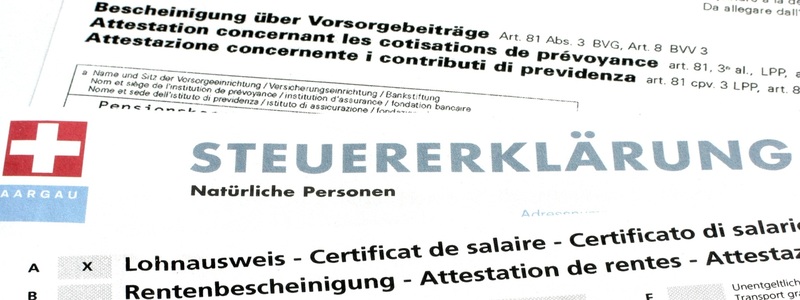
The income tax system in Switzerland depends on your residence permit:
Permit B: Residence permit valid for one to five years for EU nationals, with withholding tax. The tax is deducted directly from the employee's salary by the employer and then paid to the cantonal tax authorities.
Permit L: Short-term residence permit, for more than four months and less than one year. The principle is the same as for Permit B.
Permit C: After five years of residence and employment in Switzerland, EU nationals may obtain a settlement permit. Taxation then depends on the canton and municipality of residence, which determine the applicable tax rate.
⚠ Warning: Cross-border workers living in France and working in Switzerland are subject to withholding tax. To avoid double taxation, they must provide a French tax residence certificate (Form No. 2041-AS).
To estimate your monthly net income after tax, you can use an online tax calculator for Switzerland. The amount varies in particular depending on your canton of residence and employment:
- Swiss Trade Union Federation salary calculator
- National salary calculator for Switzerland
- Salary calculator for Geneva
- Salary calculator for the canton of Zurich
- Salary calculator for the canton of Vaud
- Salary calculator for the canton of Fribourg
- Salary calculator for the canton of Neuchâtel
Unlike France, where employers are required to cover a significant portion of social security contributions, in Switzerland, the Federal Health Insurance Act provides that employees must take out health insurance at their own expense.
In addition, everyone residing in Switzerland must take out compulsory health insurance (LAMal) within three months of settling in the country.
In 2026, the average monthly health insurance premiums in Switzerland amount to:
- Adults: CHF 465.30
- Young adults: CHF 326.30
- Children: CHF 122.50
- Average for all insured persons: CHF 393.30
💡 Tip: These premiums therefore represent a significant expense to include in your budget, particularly when estimating your actual disposable income and remaining budget more accurately.

The Swiss salary certificate provides a quick overview of how your gross salary is converted into net income. It details social security contributions, any bonuses and various deductions.
The main deductions include:
- AHV/IV/EO: Old-age, disability and loss-of-earnings insurance
- ALV: Unemployment insurance
- BVG: Occupational pension scheme
- Accident insurance: In particular for non-occupational accidents
- Withholding tax: Where applicable
While a French payslip contains more than 30 contribution items, there are only 13 in Switzerland! The Swiss payslip is structured into three sections:
- your gross income (monthly salary, overtime, daily allowances, bonuses, sickness benefits, etc.)
- the contributions (employer's share, social security, pension, etc.)
- your net salary
📝 Please note: The payslip may also show a 13th-month salary, bonuses, allowances or overtime payments.
Visit HelloSafe Switzerland for more tools.

Salary negotiation is generally part of the recruitment process. To effectively communicate your salary expectations, it is better to go into the interview with a realistic estimate of the salary corresponding to your profession, experience, level of education and canton.
Don't give a random figure: Before negotiating, research the salaries offered in your sector. Differences can be significant depending on the profession and region. Then set yourself a salary range, with a minimum amount below which you do not wish to go.
Highlight your profile: Your experience, language skills, qualifications and specialization can all be valuable negotiation arguments. For a Franco-Swiss or Franco-German profile, speaking several languages can be particularly relevant in international companies.
How to answer the question about salary expectations: When the recruiter asks about your salary expectations, opt for a range rather than a fixed amount, taking into account your experience, the position and the benefits offered. This gives you room for negotiation.
Think beyond salary: Base salary is not the only negotiable element. Also consider the 13th-month salary, bonuses, performance-related payments, holidays, remote working, working hours, employee benefits and employer contributions to occupational pension schemes.
Find out more:
- Job boards in Switzerland: The best platforms
- Average salary in Europe: Country ranking
- Minimum wage in Europe: Country ranking

Olivier Geslin








Vorgeschlagene Artikel zum gleichen Thema